The Real Reason Customers Abandon Carts
Category: E-commerce & Conversion Optimization
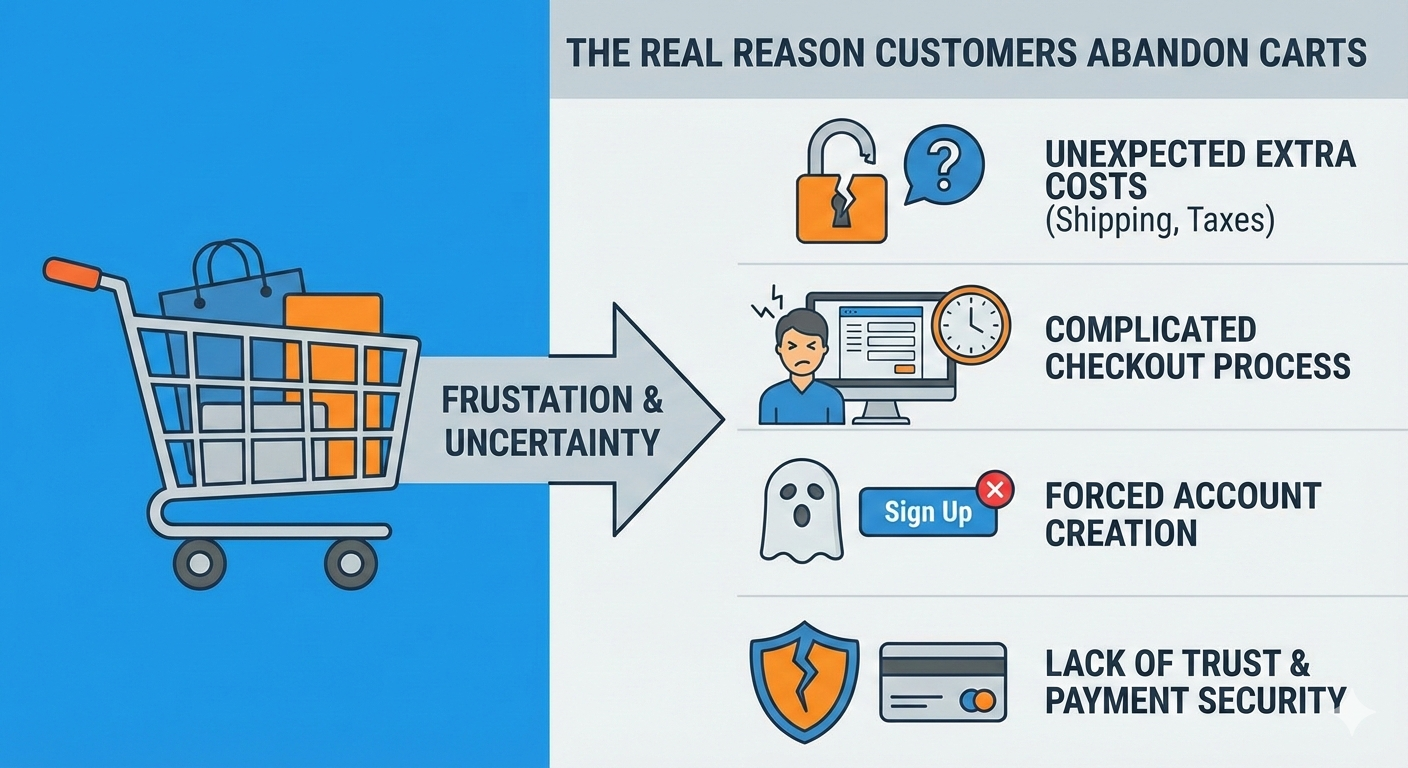
Cart abandonment is a persistent problem for e-commerce businesses. While price is often blamed, the deeper issue is friction and hesitation during the checkout process. In India’s rapidly growing e-commerce market, where customers have dozens of shopping options, understanding why users leave without purchasing is critical for survival.
Research shows that the average cart abandonment rate hovers around 70%. But here’s the truth: most of those lost sales aren’t about money—they’re about trust, clarity, and momentum.
Understanding Friction

Friction occurs when customers experience uncertainty or inconvenience during the buying journey. It’s like stepping on the brakes while driving—each moment of friction slows momentum until the customer stops completely.
Common Friction Points:
- Unexpected shipping costs – The #1 reason for abandonment globally
- Complicated checkout forms – Too many fields, unclear instructions
- Mandatory account creation – Forces commitment before value is proven
- Slow-loading pages – Every second costs conversions
- Lack of trust indicators – No security badges, unclear policies
- Limited payment options – Missing UPI, COD, or popular local methods
Even small doubts stack up like weights on a scale. Individually, each might seem minor, but together they push users to exit without buying.
The Psychology of Abandonment

Checkout requires emotional commitment. When a customer adds items to cart, they’ve already made a preliminary decision to buy. But the checkout process introduces micro-doubts—small questions that trigger hesitation:
- “Is my payment information secure?”
- “What if this doesn’t fit or look good?”
- “Will it arrive on time?”
- “Is there a better price elsewhere?”
- “What if I need to return it?”
These micro-doubts are often more decisive than the actual price. Brands that anticipate and remove these psychological barriers see dramatically higher conversion rates.
Table: Common Abandonment Causes and Solutions
| Cause | Solution |
|---|---|
| Unexpected fees (shipping, taxes) | Display all costs upfront, offer free shipping thresholds |
| Complicated checkout process | Simplify form fields, allow guest checkout, auto-fill addresses |
| Lack of trust/security concerns | Add secure payment badges, SSL certificates, customer testimonials |
| Slow page load | Optimize images, minimize scripts, use faster hosting |
| Return policy uncertainty | Clearly state easy return options, link to policy prominently |
| Limited payment methods | Accept UPI, cards, net banking, COD, and popular wallets |
| Required account creation | Offer guest checkout with option to create account after purchase |
The Mobile Checkout Challenge

In India, over 75% of e-commerce traffic comes from mobile devices. Yet many checkout experiences are still designed for desktop. Tiny buttons, hard-to-read text, and forms that require constant zooming create massive friction.
Mobile-optimized checkout means:
- Thumb-friendly buttons and form fields
- Auto-detection of OTPs for verification
- Saved payment methods for returning customers
- Progress indicators showing how many steps remain
- One-click checkout options where possible
Building Trust at Critical Moments
Trust isn’t built once—it’s reinforced at every decision point. Strategic placement of trust signals can dramatically reduce abandonment:
- Security badges near payment fields
- Money-back guarantees prominently displayed
- Customer photos of products in real life
- Live chat available during checkout
- Clear delivery timelines with tracking information
- Cart abandonment often reflects uncertainty rather than price sensitivity. Removing doubts is more effective than discounting.
- Transparency builds momentum. Surprises at checkout break trust built earlier in the journey.
- Simplifying the checkout process respects customer time and reduces decision fatigue.
- Reassurance at critical moments strengthens confidence and encourages completion.
- Optimizing checkout is a psychological strategy as much as a technical task. Understanding the customer’s mindset is essential to reduce abandonment.
- Mobile optimization isn’t optional—it’s essential for Indian e-commerce success.
- Multiple payment options signal that you understand diverse customer preferences.
Reader Reviews
Reader Summary
Based on 47 verified reviews from e-commerce professionals
- 94% of readers found practical solutions they could implement immediately
- 4.8/5 average rating for actionable insights
- Most valued sections: Psychology of Abandonment & Mobile Checkout Challenge
- Highly recommended for e-commerce managers, founders, and conversion optimizers
The micro-doubts framework completely changed how I think about checkout. We added security badges near payment and saw abandonment drop by 12% in two weeks. The section on unexpected costs was eye-opening—we immediately started displaying shipping estimates on product pages rather than waiting until checkout. This single change recovered nearly ₹2.8L in abandoned carts last month alone.
This article helped me realize we were hiding shipping costs until the last step. Displaying them upfront felt scary but actually increased conversions by 18%. The psychology section about “micro-doubts” explains exactly why customers were dropping off at payment. We also added a simple return policy popup near the checkout button—returns dropped by 22% because customers felt more confident. Worth reading twice.
The mobile checkout section is gold. Most Indian e-commerce sites still struggle with thumb-friendly design. I shared this with my entire product team and we’re now auditing our checkout flow based on the friction points listed here. The table of causes and solutions is particularly useful—I’ve pinned it to our team Slack channel. Would love to see a follow-up focused specifically on UPI payment optimization.
Finally an article that understands Indian consumers—UPI, COD, and return policies are make-or-break here. Well researched and practical. The point about “momentum” in checkout really resonated: every extra click gives customers time to second-guess. We simplified our 5-step checkout to 3 steps based on this framework and saw a 31% reduction in abandonment within 10 days.
The distinction between price sensitivity and uncertainty is crucial. We were running constant discount campaigns trying to reduce abandonment, but this article helped us see that trust was the real issue. Added customer review snippets and trust badges strategically throughout checkout, and conversion rates improved without any discounts. This is the kind of practical psychology every e-commerce team needs.
As a small business, we couldn’t figure out why customers were adding vegetables to cart and then leaving. Turns out it was delivery time uncertainty—not price. Added a clear delivery slot selector early in checkout and abandonment dropped by 27%. The psychology of “micro-doubts” explained exactly what was happening. Simple, clear, and immediately useful.